
SOLAS V/23: New pilot transfer requirements for yachts
WHAT HAS CHANGED
Beginning 1 January 2028, new mandatory requirements will apply to the arrangements used to transfer pilots to and from ships. Depending on their size, use and flag, many yachts will be affected, both those in operation and those under construction.
The IMO has amended SOLAS Regulation V/23 (Resolution MSC.572(110)) and made the Performance Standards for Pilot Transfer Arrangements mandatory (Resolution MSC.576(110)). The standards cover the design, construction, installation, inspection, maintenance, replacement and approval of pilot ladders and associated equipment, as well as crew familiarization.
For owners, the practical consequences include equipment and structural changes, new onboard procedures and, for yachts under construction, potential changes to the specification and the build contract.
TIMELINE
The amendments enter into force on 1 January 2028, and compliance dates depend on when the arrangement is installed and on the type of vessel.
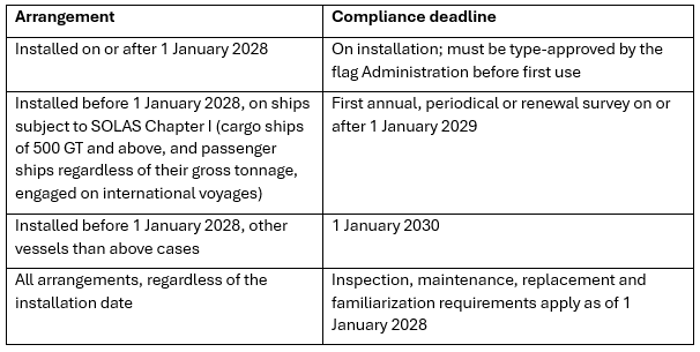
"Installed" refers to the contractual delivery date of the pilot transfer arrangement to the ship or, in the absence of this date, its actual delivery date on board. It does not mean the delivery date of the vessel.
YACHTS IN OPERATION
Existing yachts within scope will need a review of their equipment, structure and procedures before the applicable deadline. The main requirements are:
Mechanical pilot hoists are prohibited.
Strong points and securing arrangements must have a documented minimum breaking strength of 48 kN. Where documentation is missing, replacement may be the most reliable route to compliance.
Pilot ladders and manropes (including their spares) must be withdrawn from service if at any time they do not comply with the new mandatory performance standards and, in any case, no later than 36 months after the date of manufacture or 30 months after being placed in service, whichever is earlier. At least one compliant spare ladder and one spare set of manropes must be carried, and steps or spreaders shall not be repaired on board.
A maintenance plan shall be developed and made available for inspection.
Inspections are required before and after each use, with a detailed inspection every three months. These must be incorporated into the yacht's safety management system.
Crew familiarization is required for everyone involved in rigging, inspecting or operating the equipment.
Lighting must illuminate the overside arrangements and the embarkation point.
Pilots may refuse to board until an arrangement that appears non-compliant is corrected. This can delay port entry and impact operational schedules, as well as affect the vessel's overall statutory compliance status.
YACHTS UNDER CONSTRUCTION
Builds delivering from 2028 onwards should address the new requirements now to ensure they are fully integrated into the yacht's technical specification and design approvals.
Where a pilot transfer arrangement is contractually delivered before 1 January 2028 but the yacht is delivered on or after 1 January 2029, the initial survey counts as the first survey. The yacht must therefore comply at delivery. Arrangements delivered on or after 1 January 2028 must comply on installation in any event.
On the technical side, owners and their project teams should check the specification, the yard's equipment orders and the deck layout, including strong points, side door clearances (2,200 mm by 915 mm), ladder winch reels and lighting.
Rules and regulations often change during a newbuild project. The specific technical requirements for pilot transfer arrangements will depend on the contractual dates and the applicable statutory framework. Stakeholders are advised to review these compliance requirements with the shipyard as early as possible to ensure all technical standards are met prior to the vessel’s delivery.
APPLICATION TO YACHTS AND DEVELOPMENTS TO WATCH
Whether the requirements apply to a given yacht depends on its size, its use and its flag.
SOLAS Chapter V, including Regulation V/23, applies to ships on all voyages, subject to limited exceptions, and is not limited by tonnage in the way the Chapter I survey and certification regime is. Commercially operated yachts on international voyages are therefore the clearest cases. For private yachts and yachts certified under yacht codes (such as the Red Ensign Group Yacht Code), the position depends on how the flag Administration applies Chapter V and the new standards. Even where the rules do not strictly apply, pilotage authorities and Port State Control may still expect compliant arrangements in practice.
Yacht builders have raised concerns about the requirements, in particular their impact on yacht design. Discussions involving Industry and Class are under way on whether flag yacht codes could provide special considerations for yachts. Any relaxation would ultimately require acceptance by the flag Administrations and pilot associations.
Owners should not plan on the basis of a relaxation until one is confirmed by their flag.
RECCOMMENDED ACTIONS
Owners, managers and buyers should take the following steps now:
Confirm the applicable regime for each yacht with its flag Administration and classification society.
Carry out a gap assessment of existing pilot transfer arrangements against the new performance standards.
Align required structural changes, where possible, with the yacht’s planned refits and survey schedule prior to the regulatory deadline to ensure timely compliance.
For yachts under construction, review the technical specification and coordinate early with the yard so that the new regulatory requirements are incorporated prior to delivery.
For acquisitions, include pilot transfer arrangements in the scope of the pre-purchase survey to verify statutory compliance before taking over the vessel.
Update the Safety Management System, inspection records and crew familiarization procedures, and develop the maintenance plan.
AUTHORS
Ezio Dal Maso | Partner | Stephenson Harwood Paris | Tel: +33 144 15 8000 | LinkedIn | Email: ezio.dalmaso@stephensonharwood.com
Daniele Bottino | Manager, Regional Business Development | ABS Copenhagen | Tel: +45 3910 0648 | LinkedIn | Email: dbottino@eagle.org
SOURCES
Resolution MSC.572(110): Amendments to SOLAS Chapter V Regulation 23, which make the performance standards for pilot transfer arrangements mandatory.
Resolution MSC. 576(110): Performance Standards for Pilot Transfer Arrangements, which contain detailed requirements for design, manufacture, construction, inspection, maintenance, replacement, rigging and training.
MSC.1/Circ.1690: imo circular, which Encourages the voluntary early implementation of the new SOLAS amendments.
This alert is for general information only and does not constitute legal advice. Specific advice should be sought on particular circumstances.
Prepared jointly by Stephenson Harwood and ABS Europe.
Share Article
Related Expertise
Contributors

Related Articles

The Griffon flies to the Supreme Court: long-standing decision on the Norwegian Saleform to be reviewed

Too little too late? The FCA adopts most of the Mills Review’s recommendations, but where are the AI rules?

Financing the next generation of greener yachts

The Autumn Budget 2026: key changes affecting individuals and trusts

Testing the limits of war risk – increased relevance of war risk clauses

Yachting, AML and anti-terrorist financing – sanctions regime, recent litigation and operational aspects

Yachting, AML and anti-terrorist financing – reporting obligations, beneficial ownership transparency and the updated Monegasque framework
